
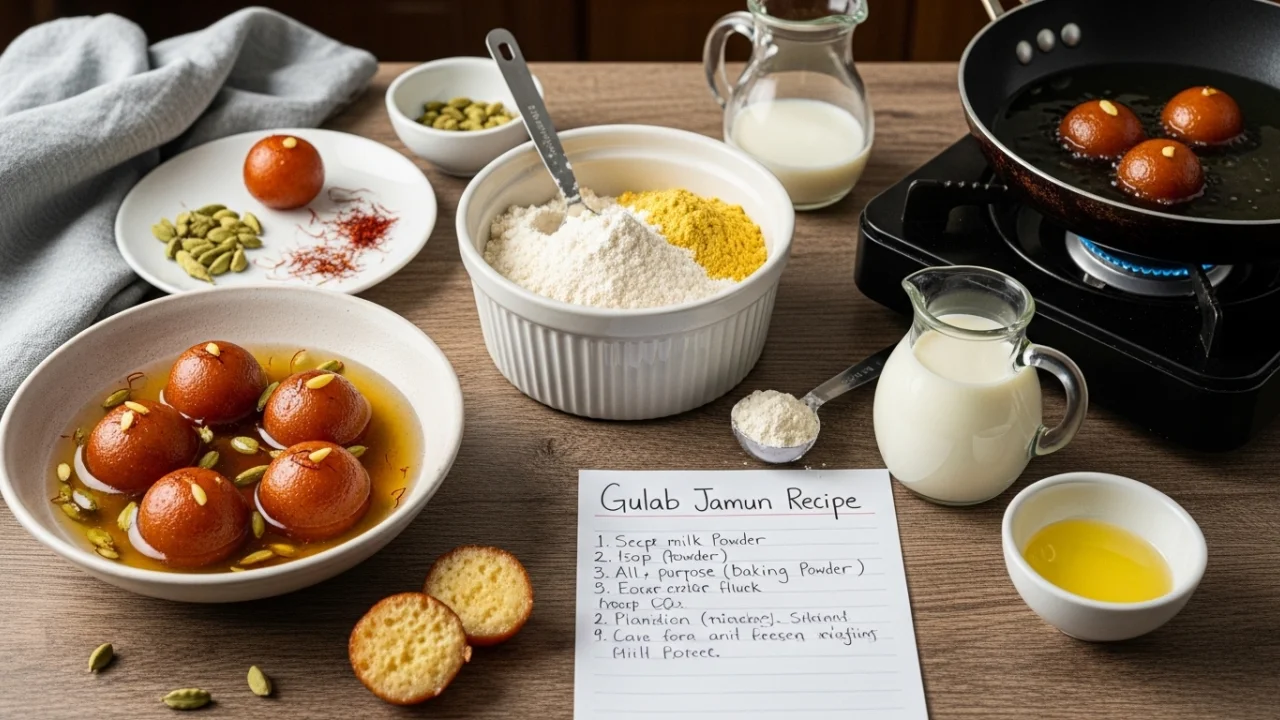
Gulab Jamun Recipe: Soft, Spongy Indian Sweet in 60 Minutes with Perfect Syrup
Published: March 21, 2026 | Category: Indian Desserts | Reading Time: 6 minutes
Introduction to Gulab Jamun
Gulab Jamun ranks among the most celebrated desserts in Indian cuisine, featuring across weddings, festivals, and special celebrations. These soft, spongy milk-solid balls are deep-fried until golden, then soaked in fragrant sugar syrup flavored with cardamom and rose water.
The primary challenges in preparing gulab jamun at home include achieving the correct dough consistency, preventing cracks during frying, ensuring proper cooking without raw centers, and creating the ideal syrup consistency. Many homemade versions result in hard, dense balls or overly sweet, sticky desserts.
This recipe addresses these issues through specific techniques: proper khoya-to-flour ratio, correct dough kneading method, precise oil temperature control, and systematic syrup preparation. Following these methods ensures restaurant-quality results with soft texture and balanced sweetness.
Traditional gulab jamun preparation requires attention to detail but becomes straightforward when approached systematically with proper measurements and timing.
Recipe Overview
| Parameter | Details |
|---|---|
| Cuisine Type | Indian |
| Course | Dessert |
| Difficulty Level | Medium |
| Prep Time | 20 minutes |
| Cook Time | 40 minutes |
| Total Time | 60 minutes |
| Servings | 20-22 pieces |
| Calories per Piece | Approx. 150 kcal |
| Dietary | Vegetarian |
| Estimated Cost | $6 – $8 |
Required Ingredients
For Gulab Jamun Balls:
- Khoya (mawa) – 200 grams (Substitute: 1 cup milk powder works but texture differs)
- Paneer – 50 grams, grated fine (Substitute: additional khoya, though paneer adds softness)
- All-purpose flour (maida) – 3 tablespoons
- Semolina (sooji) – 1 tablespoon
- Baking soda – 1/4 teaspoon (critical for spongy texture)
- Cardamom powder – 1/4 teaspoon
- Milk – 2-3 tablespoons (for binding dough)
- Ghee – 1 teaspoon (for dough)
- Oil or ghee – for deep frying (approximately 500ml)
For Sugar Syrup:
- Sugar – 2 cups
- Water – 2 cups
- Cardamom pods – 4-5, lightly crushed
- Saffron strands – 8-10 (optional but recommended)
- Rose water – 1 teaspoon
- Lemon juice – 1/2 teaspoon (prevents crystallization)
For Garnish:
- Pistachios – 10-12, slivered
- Almonds – 8-10, slivered
- Rose petals – dried, edible (optional)
Kitchen Equipment Needed
- Heavy-bottomed pan for frying
- Wide, shallow pan for syrup
- Mixing bowl
- Slotted spoon
- Kitchen thermometer (optional but helpful)
- Grater for paneer
Step-by-Step Preparation Method
Phase 1: Syrup Preparation
Step 1: Making Sugar Syrup
Combine 2 cups sugar and 2 cups water in wide, shallow pan. Add crushed cardamom pods and saffron strands. Bring to boil over medium-high heat, stirring until sugar dissolves completely.
Add lemon juice once boiling begins. This prevents sugar crystallization during storage. Reduce heat to low and simmer for 8-10 minutes until syrup reaches one-string consistency.
Consistency test: Dip spoon in syrup, let cool slightly, then touch between thumb and finger. When pulled apart, single thread should form. This indicates proper thickness.
Turn off heat. Add rose water and stir. Keep syrup warm while preparing gulab jamuns. Cold syrup doesn’t absorb properly into fried balls.
Phase 2: Dough Preparation
Step 2: Combining Dry Ingredients
Grate khoya finely using box grater. Grate paneer similarly. Place both in mixing bowl.
Add all-purpose flour, semolina, baking soda, cardamom powder, and ghee. Mix gently using fingertips. The mixture should resemble breadcrumbs.
Important note: Over-mixing at this stage develops gluten, resulting in hard gulab jamuns. Light mixing is essential.
Step 3: Dough Formation
Add milk gradually, one tablespoon at a time. Gently bring mixture together into soft dough. The dough should be just cohesive enough to shape, not kneaded smooth.
Critical texture: Dough should be soft, slightly crumbly, and hold shape when pressed. If too dry, add milk drops at a time. If sticky, add pinch of flour.
Avoid kneading vigorously. Gentle pressing and folding suffices. Over-kneaded dough produces dense, hard gulab jamuns.
Rest dough for 10 minutes covered with damp cloth. This relaxes gluten and makes shaping easier.
Step 4: Shaping Balls
Divide dough into 20-22 equal portions (approximately 12-15 grams each). Roll each portion between palms into smooth, crack-free balls.
Shaping technique: Apply light pressure while rolling. Ensure surface is completely smooth without cracks. Any surface imperfection causes balls to break during frying or develop hard spots.
Keep shaped balls covered to prevent drying. Arrange on plate without touching each other.
Phase 3: Frying Process
Step 5: Oil Temperature Management
Heat oil or ghee in heavy-bottomed pan over medium heat. Oil depth should be minimum 2-3 inches for proper frying.
Test temperature by dropping small dough piece. It should sink slightly, then rise slowly. If rises immediately, oil is too hot. If remains at bottom, oil is too cold. Ideal temperature is 140-150°C (285-300°F).
Temperature importance: This is lower than typical frying temperature. Low heat ensures even cooking throughout without burning exterior.
Step 6: Frying Technique
Gently slide 5-6 balls into oil. Don’t overcrowd as this reduces temperature significantly.
Balls will sink initially, then slowly rise and begin expanding. Using slotted spoon, rotate gently and continuously. This ensures even browning on all sides.
Fry on low-medium heat for 10-12 minutes until balls turn deep golden brown. The slow frying ensures centers cook completely while exterior browns evenly.
Doneness check: Properly fried gulab jamun should be uniformly golden-brown, feel light when lifted, and not have raw smell.
Remove using slotted spoon and drain briefly on paper towels (maximum 30 seconds).
Step 7: Syrup Soaking
Immediately transfer hot fried balls into warm syrup. They should be hot when entering syrup for proper absorption.
Let soak for minimum 2 hours. Gulab jamuns will expand significantly, doubling in size as they absorb syrup.
Turn balls gently after 1 hour to ensure even soaking on all sides.
Professional Techniques and Tips
🔥 Technique 1: Khoya-Paneer Balance
The 4:1 ratio of khoya to paneer creates optimal texture. Khoya provides authentic flavor and structure, while paneer adds moisture and softness. Using only khoya produces denser gulab jamuns; only paneer lacks traditional taste. This specific ratio balances both requirements perfectly.
🔥 Technique 2: Baking Soda Proportion
Exactly 1/4 teaspoon baking soda for this quantity is critical. Excess causes bitter taste and excessive expansion leading to hollow centers. Insufficient amount results in dense texture. The precise measurement creates just enough lift for spongy texture without compromising taste.
🔥 Technique 3: Low-Temperature Frying
Maintaining 140-150°C throughout frying is essential. Higher temperature browns exterior before interior cooks, creating hard shell with raw center. Lower temperature causes oil absorption. Using kitchen thermometer ensures consistency, though visual cues (gentle bubbling, slow rising) indicate correct temperature.
🔥 Technique 4: Hot-to-Hot Transfer
Transferring hot fried gulab jamuns into warm syrup (not cold) ensures maximum absorption. The temperature differential creates slight vacuum effect as balls cool, drawing syrup into interior. This technique produces characteristically juicy texture.
Common Problems and Solutions
Problem 1: Gulab Jamuns Breaking During Frying
Cause: Cracks in shaped balls, oil temperature too high, or insufficient khoya binding.
Solution: If breaking occurs, remove from oil immediately. Reshape dough adding 1 tablespoon milk powder for better binding. Ensure balls are completely smooth and crack-free before frying. Reduce oil temperature.
Prevention: Roll balls with light, even pressure ensuring smooth surface. Check oil temperature carefully before starting.
Problem 2: Hard, Dense Texture
Cause: Over-kneading dough, excessive flour proportion, or frying at high temperature.
Solution: Unfortunately, hard gulab jamuns cannot be softened post-cooking. For next batch, reduce kneading, decrease flour by 1 tablespoon, and maintain lower frying temperature.
Prevention: Handle dough minimally. Add flour only as needed for binding. Fry at controlled low temperature.
Problem 3: Raw Centers
Cause: Oil temperature too high causing exterior to brown before interior cooks, or insufficient frying time.
Solution: If discovered after frying, return to warm oil and fry additional 3-4 minutes on very low heat. Soak in syrup as normal.
Prevention: Maintain 140-150°C temperature. Fry minimum 10-12 minutes per batch. Test one ball by cutting – interior should be uniformly cooked.
Problem 4: Excessively Sweet or Sticky
Cause: Syrup too thick or extended soaking time beyond necessary.
Solution: If syrup too thick, dilute with 1/4 cup water and bring to boil again. Remove gulab jamuns from syrup after 3-4 hours and store separately.
Prevention: Achieve one-string consistency for syrup. Soak gulab jamuns 2-3 hours maximum. Store in moderate amount of syrup, not completely submerged.
Serving Suggestions and Pairings
Traditional Service: Serve 2-3 pieces per person in small bowls with generous syrup. Garnish with slivered pistachios and almonds. Can be served warm, at room temperature, or chilled.
Temperature Preferences:
- Warm (slightly heated) – Traditional serving method, enhances aroma
- Room temperature – Most common, balanced flavor
- Chilled (refrigerated 2 hours) – Preferred in summer, firmer texture
Accompaniments:
- Vanilla ice cream for fusion dessert
- Rabri (thickened sweetened milk) for rich combination
- Fresh cream for lighter option
Festive Presentation: Arrange on decorative platter, drizzle with reduced syrup, garnish with edible silver leaf (vark) and rose petals.
Storage and Reheating Instructions
Room Temperature: Store in airtight container with syrup for 2-3 days maximum in cool climate. Not recommended in hot, humid conditions.
Refrigeration: Transfer to container with sufficient syrup to keep moist. Refrigerate for up to 1 week. Bring to room temperature 30 minutes before serving or warm gently.
Freezing: Not recommended as texture changes significantly upon thawing. If necessary, freeze without syrup for maximum 2 weeks.
Reheating: Microwave for 15-20 seconds on medium power, or warm in syrup over low heat for 2-3 minutes. Avoid overheating which causes hardening.
Nutritional Information
Per Piece (1 gulab jamun):
- Calories: 150 kcal
- Protein: 3g
- Carbohydrates: 22g
- Fat: 6g
- Sugar: 18g
- Sodium: 15mg
Health Considerations: High in sugar and calories. Suitable for occasional consumption. Diabetics should avoid or consult healthcare provider. Contains dairy – not suitable for lactose-intolerant individuals without modification.
Variations and Adaptations
Kala Jamun: Add 1 tablespoon cocoa powder to dough for darker color and chocolate notes. Popular in certain regions.
Milk Powder Version: Replace khoya with 2 cups milk powder. Add 4-5 tablespoons cream for binding. Texture differs but acceptable alternative.
Sugar-Free: Use sugar substitute in syrup. Reduce to 1.5 cups substitute as sweetness differs. Note that texture of syrup changes.
Stuffed Gulab Jamun: Place small piece of dry fruit, nuts, or chocolate chip in center while shaping. Creates surprise element.
Frequently Asked Questions
Q1: Can gulab jamun be made without khoya?
Yes, using milk powder as substitute. Combine 2 cups milk powder, 1/4 cup all-purpose flour, 1/4 teaspoon baking soda, and 4-5 tablespoons cream. Results differ in texture and taste but remain acceptable. Traditional khoya-based version is superior.
Q2: Why do gulab jamuns sometimes remain hard even after soaking?
Primary causes include over-kneading dough, high-temperature frying, or transferring cold balls into syrup. Ensure minimal kneading, controlled frying temperature, and hot-to-warm transfer for proper absorption.
Q3: How long should gulab jamuns soak in syrup?
Minimum 2 hours for adequate absorption and expansion. Maximum 4-5 hours for optimal texture. Extended soaking (overnight) makes them overly sweet and changes texture. For storage, remove from excess syrup after 3-4 hours.
Q4: Can gulab jamun be made in advance for parties?
Yes, ideal make-ahead dessert. Prepare 1-2 days before event. Store refrigerated with moderate syrup. Quality remains excellent for 3-4 days when properly refrigerated. Bring to room temperature before serving.
Conclusion
Gulab Jamun preparation requires attention to dough consistency, frying temperature, and syrup concentration. Success depends on mastering specific techniques: gentle dough handling, low-temperature frying, and proper hot-to-warm transfer for syrup absorption.
While recipe involves multiple steps, systematic approach makes process manageable. The result – soft, spongy, perfectly sweet gulab jamuns – justifies the careful attention required. This dessert remains centerpiece at celebrations and represents comfort food for countless occasions.
Proper technique produces restaurant-quality results consistently, making this traditional sweet accessible for home preparation.