
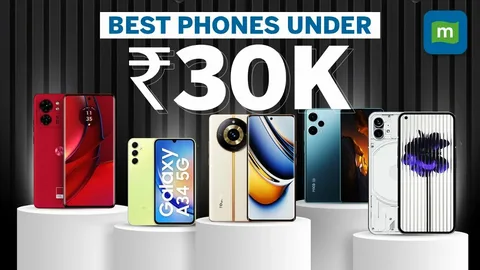
The ₹30,000 smartphone segment is where things get seriously interesting. At this price, you can move beyond basic mid-range hardware and start getting phones with flagship-style displays, powerful processors, capable cameras, fast charging and much better build quality.
If your budget is around ₹30,000 in 2026, you don’t necessarily need to spend twice as much for a premium everyday experience.
The key is choosing the right phone for your priorities.
Quick Picks
| Phone | Best For | Main Strength |
|---|---|---|
| OnePlus Nord 5 | Performance | Powerful processor |
| Nothing Phone (3a) Pro | Design & cameras | Clean software |
| Motorola Edge 60 Pro | Display | Premium screen |
| realme GT series | Gaming | Performance |
| iQOO Neo series | Gaming | Processor + cooling |
| Samsung Galaxy A series | Software | Samsung ecosystem |
| Xiaomi/Redmi Note Pro+ | Camera & display | Feature-packed hardware |
| Pixel A series | Photography | Computational photography |
Prices fluctuate considerably during sales, so consider the current selling price rather than the launch price.
Why ₹30,000 Is a Sweet Spot
The biggest advantage of spending around ₹30,000 is that you can start getting features normally associated with much more expensive smartphones.
Depending on the model, you may get:
- AMOLED or LTPO displays
- 120Hz refresh rates
- Powerful Snapdragon or MediaTek processors
- OIS cameras
- Large batteries
- Fast charging
- Premium glass or vegan-leather finishes
- Stereo speakers
- 5G
- Long software support
- Advanced AI features
The difference between a ₹20,000 phone and a ₹30,000 phone isn’t always dramatic.
But the best ₹30,000 models can offer a noticeably more polished experience.
1. OnePlus Nord 5
OnePlus remains a strong choice for users who prioritize speed.
The Nord 5 focuses on performance, display quality and charging.
Its powerful chipset makes it suitable for demanding applications, multitasking and gaming.
The phone also features a high-refresh-rate AMOLED display, which makes everyday interaction feel smooth.
OnePlus’ OxygenOS software is another advantage.
It’s relatively clean while still providing plenty of customization options.
For users who want a fast phone without paying flagship prices, the Nord 5 is an excellent starting point.
Best for:
Performance-focused users and gamers.
2. Nothing Phone (3a) Pro
Nothing has carved out a unique space in the smartphone market.
Instead of making phones that look like every other Android device, the company emphasizes design.
The Nothing Phone (3a) Pro combines that distinctive appearance with a clean software experience.
Its camera system is also more ambitious than what you typically find on affordable smartphones.
Nothing OS remains one of the more visually distinctive Android interfaces.
The result is a phone that feels different without becoming unnecessarily complicated.
Best for:
Design-conscious users who want clean software and capable cameras.
3. Motorola Edge 60 Pro
Motorola’s Edge series has increasingly focused on premium design and display quality.
The Edge 60 Pro is particularly appealing to people who spend a lot of time consuming media.
A high-quality AMOLED display makes:
- YouTube
- Netflix
- Gaming
- Web browsing
more enjoyable.
Motorola’s relatively clean Android interface is another attraction.
If you dislike excessive pre-installed applications and aggressive software modifications, Motorola is worth considering.
Best for:
Display lovers and stock-Android fans.
4. realme GT Series
If performance is your priority, the realme GT family deserves attention.
GT phones generally focus heavily on processors, charging and gaming.
A powerful processor is especially useful if you plan to keep your phone for several years.
As applications become more demanding, additional processing headroom can help the phone remain responsive.
The fast charging technology is another major attraction.
For heavy users, being able to quickly recharge the phone can be more convenient than carrying a power bank everywhere.
Best for:
Gamers and heavy users.
5. iQOO Neo Series
iQOO has developed a reputation for building phones that prioritize performance.
The Neo lineup is particularly attractive for gaming.
The combination of:
- Powerful chipset
- High-refresh-rate display
- Large battery
- Fast charging
- Gaming optimization
makes these phones suitable for people who spend hours playing demanding mobile games.
The camera system may not always be the strongest in the segment, but that’s because iQOO prioritizes performance.
If you want a gaming machine disguised as a smartphone, this is the neighborhood to investigate.
Best for:
Serious mobile gamers.
6. Samsung Galaxy A Series
Samsung takes a different approach.
Rather than competing purely on processor specifications, Galaxy A-series phones focus on the overall user experience.
You get access to Samsung’s software ecosystem, Galaxy services and a familiar interface.
Samsung also has a strong service network in India.
That’s something worth considering if you don’t want to rely entirely on online support.
For users who prioritize reliability, software support and ecosystem integration, Samsung can be more attractive than a phone with a faster processor but weaker long-term support.
Best for:
Everyday users who value software and reliability.
7. Redmi Note Pro+ Series
Redmi’s higher-end Note models often deliver impressive specifications for the price.
These phones typically focus on:
- High-quality displays
- Large batteries
- Fast charging
- High-resolution cameras
- Strong processors
They’re particularly attractive to buyers who want a lot of hardware.
The downside is that Xiaomi’s software can feel more feature-heavy than Motorola or Nothing.
Some users will love the customization.
Others will prefer something simpler.
Best for:
People who want maximum hardware for their money.
8. Google Pixel A Series
Google’s Pixel A-series phones are unusual in this category.
They don’t always win specification battles.
Instead, they rely heavily on Google’s computational photography and software optimization.
Pixel phones are particularly good for people who want:
- Natural-looking photographs
- Excellent HDR
- Strong portrait photography
- Clean Android
- Google’s AI features
The camera processing can make a significant difference.
A Pixel may have fewer megapixels than a competing phone but still produce better-looking photographs.
That’s the magic of computational photography.
What Should You Look for in a ₹30,000 Phone?
Once you’re spending ₹30,000, expectations should increase.
Don’t simply buy the phone with the largest number on the specification sheet.
Instead, consider the entire experience.
Processor
At this price, you should expect a relatively powerful chipset.
A strong processor helps with:
- Gaming
- Video editing
- AI applications
- Multitasking
- Camera processing
- Long-term performance
If you plan to keep the phone for four years, processor performance becomes especially important.
Display
A ₹30,000 phone should ideally have a high-quality AMOLED display.
Look for:
120Hz refresh rate
and preferably strong outdoor brightness.
If you frequently watch videos or play games, display quality can have a bigger daily impact than camera megapixels.
A beautiful display is something you’ll interact with every time you unlock the phone.
Camera
This is where ₹30,000 phones can become genuinely interesting.
Look for:
- OIS
- Good primary sensor
- Ultrawide camera
- Telephoto camera if available
- Good night mode
- 4K video
- Reliable autofocus
Don’t automatically assume that three or four cameras means better photography.
Sometimes two excellent cameras are better than four mediocre ones.
Battery
Most modern phones around ₹30,000 offer large batteries.
However, battery life depends on more than capacity.
Processor efficiency and software optimization matter just as much.
A phone with a 6,000mAh battery sounds impressive, but if the software is poorly optimized, the real-world experience can still disappoint.
Charging
Fast charging is one of the most useful features in this price category.
Imagine waking up late with 15% battery.
Instead of spending an hour charging, you can plug the phone in briefly and get enough power to survive the morning.
That is the kind of feature you notice every day.
Software Updates
This is one of the most important long-term considerations.
A smartphone isn’t just a piece of hardware.
It’s also software.
Look for brands that offer several years of Android and security updates.
Longer support means:
- Better security
- New features
- Longer usable life
- Better resale value
Google and Samsung are particularly strong considerations if software longevity is a priority.
Gaming Performance
If gaming is your priority, don’t spend most of your budget on camera hardware.
Instead, prioritize:
- Processor
- Cooling
- Display
- Battery
- Charging
This is where iQOO, OnePlus and realme can be particularly attractive.
A powerful processor combined with good thermal management can deliver significantly better gaming performance.
Photography Performance
If cameras matter most, the buying strategy changes.
Google Pixel is particularly strong for computational photography.
Samsung offers a balanced camera experience.
Motorola, OnePlus, Xiaomi and Nothing can also be attractive depending on the specific model.
When comparing cameras, look at actual sample photographs rather than relying only on specifications.
A 50MP camera isn’t automatically better than a 48MP camera.
The sensor, lens, stabilization and software all matter.
Battery Champion
If battery life is your top priority, look toward models from realme, OnePlus, Xiaomi and other manufacturers that offer large batteries and fast charging.
But remember:
Battery capacity ≠ battery life.
The processor, display and software all affect endurance.
Best ₹30,000 Phone for Students
Students usually need a phone that can handle:
- Online classes
- Social media
- Video calls
- Notes
- Photography
- Streaming
- Gaming
A balanced phone such as a OnePlus, Motorola, Samsung or Nothing model can work well.
Don’t overspend on a gaming phone unless gaming is actually one of your priorities.
Best ₹30,000 Phone for Content Creators
For creators, prioritize:
- Camera quality
- Video stabilization
- Storage
- Processor
- Display
- Battery
If you’re making TikTok, Instagram Reels or YouTube videos, video quality can be more important than raw gaming performance.
A phone with good stabilization and reliable autofocus can save you a lot of editing headaches.
Best Phone for Long-Term Use
If you intend to keep your phone for four or five years, software support becomes critical.
You should prioritize:
- Long update policy
- Efficient processor
- Large battery
- Durable build
- Adequate storage
Samsung and Google are particularly worth considering for long-term software support.
Is ₹30,000 Enough for a Premium Experience?
For many users, yes.
You may miss some flagship features such as:
- Ultra-premium materials
- Periscope cameras
- The fastest processors
- Advanced telephoto systems
- Extremely bright displays
But the day-to-day experience can still be excellent.
You can get:
Fast performance + excellent display + good cameras + long battery + 5G
without spending flagship money.
That’s why this price range is so attractive.
Should You Buy a ₹30,000 Phone or a ₹50,000 Phone?
It depends on what you need.
A ₹50,000 phone may provide better:
- Cameras
- Build quality
- Processor
- Display
- Haptics
- Water resistance
But if you mostly use:
- YouTube
- Netflix
- Browsing
- Photography
- Casual gaming
a good ₹30,000 phone can be more than enough.
The extra ₹20,000 may provide improvements that you notice only occasionally.
Final Verdict
The ₹30,000 smartphone segment is one of the best places to shop in India in 2026.
For performance, OnePlus Nord 5 is an excellent option.
For design and software, Nothing Phone (3a) Pro is worth considering.
For display quality and clean software, Motorola Edge 60 Pro stands out.
For gaming, look toward iQOO Neo and realme GT models.
For Samsung’s ecosystem and software support, the Galaxy A series remains attractive.
For maximum specifications, Redmi Note Pro+ models deserve attention.
And if photography is your priority, the Pixel A series should be high on your list.
The biggest mistake is choosing based purely on specifications.
Instead, decide what matters most to you first.
Gaming? Buy for the processor.
Photography? Buy for the camera system.
Battery? Buy for endurance and charging.
Software? Buy for update support.
Everything? Look for the best-balanced package.
At ₹30,000, you aren’t shopping for a cheap smartphone anymore.
You’re shopping for a phone that can genuinely last. 📱
Frequently Asked Questions
Which is the best Android phone under ₹30,000?
The best option depends on your priorities. OnePlus, Motorola, Nothing, iQOO, realme, Samsung, Redmi and Google all have compelling options in or around this range.
Which is best for gaming?
iQOO Neo and realme GT models are strong choices because they prioritize processors, cooling and charging.
Which is best for cameras?
Google Pixel A-series phones are particularly strong for computational photography, while Samsung, OnePlus, Motorola and Xiaomi offer competitive alternatives.
Is ₹30,000 enough for a phone that lasts four years?
Yes, provided you choose a model with a capable processor, sufficient storage, a durable battery and a strong software-update policy.
Should I buy a flagship instead?
Only if you specifically need flagship-level cameras, performance, materials or advanced features. For everyday use, a good ₹30,000 phone can be more than sufficient.