
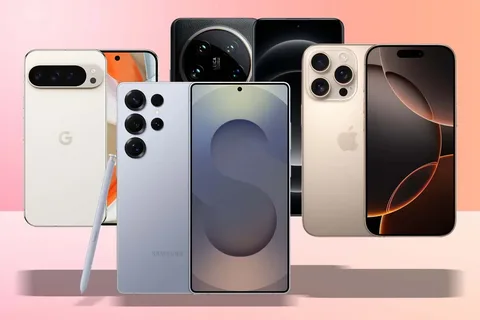
Artificial intelligence has moved from being a flashy feature in smartphone advertisements to becoming a genuine part of the everyday phone experience. In 2026, AI can help users edit photographs, summarize documents, translate conversations, search what’s on their screen, organize information, improve recordings and even assist with writing.
The important question is no longer simply “Does this phone have AI?” Almost every major smartphone brand now uses AI in some form. The better question is: “Which phone’s AI features are actually useful?”
Current 2026 rankings put phones such as the Samsung Galaxy S26 Ultra, Google Pixel 10 Pro/Pro XL, iPhone 17 Pro Max, OnePlus 15 and Xiaomi 17 Ultra among the leading AI-focused smartphones. At the more affordable end, models including the Motorola Edge 70 Fusion, realme P4 Pro and OnePlus Nord CE6 bring useful AI tools to prices below ₹30,000.
Here are the AI phones worth considering in India in 2026.
Quick Comparison
Phone Best For AI Platform
Samsung Galaxy S26 Ultra Overall AI experience Galaxy AI
Google Pixel 10 Pro XL Google AI Gemini
iPhone 17 Pro Max iOS users Apple Intelligence
OnePlus 15 Performance + AI OxygenOS AI
Xiaomi 17 Ultra AI photography HyperAI
Motorola Edge 70 Fusion AI under ₹30,000 Moto AI + Gemini
realme P4 Pro AI features under ₹30,000 realme AI
Nothing Phone (3a) Pro AI organization Nothing AI
Prices and availability vary by storage configuration and retailer.
- Samsung Galaxy S26 Ultra
If you’re looking for a smartphone that treats AI as a central part of the user experience rather than an optional extra, the Samsung Galaxy S26 Ultra is one of the strongest choices available in 2026.
Samsung’s Galaxy AI ecosystem includes tools for writing assistance, image editing, translation, transcription and screen-based search. The phone also supports features such as Live Translate and Circle to Search. Current listings show the Galaxy S26 Ultra starting around ₹1,34,999 in India, depending on the configuration.
The hardware matches the software ambitions. The S26 Ultra features a Snapdragon 8 Elite Gen 5 processor, a 6.9-inch display and a 200MP main camera.
Samsung also promises seven years of software updates, making it an interesting option for buyers who plan to keep their phone for a long time.
Best for
Users who want the most complete Android AI package.
- Google Pixel 10 Pro XL
If Samsung is building a broad AI toolbox, Google is approaching AI from the opposite direction: make the phone itself feel intelligent.
The Pixel 10 Pro XL is one of the strongest options for people who already use Google services heavily.
Google’s Gemini ecosystem integrates with the phone’s software, while Google’s computational photography has traditionally been one of the Pixel line’s biggest strengths.
Current 2026 reviews continue to highlight Google’s AI capabilities as one of the Pixel’s major advantages. The Pixel line offers tools for tasks such as voice transcription, image editing, contextual assistance and screen-based search.
The Pixel 10 Pro XL is therefore particularly appealing to people who use Gmail, Google Photos, Google Maps, Google Calendar and other Google services every day.
Best for
Google users and people who prioritize AI software over raw benchmark performance.
- iPhone 17 Pro Max
Apple has taken a different route with Apple Intelligence.
Rather than presenting AI as a separate collection of applications, Apple integrates intelligence into areas such as writing, notifications, Siri and photography.
The iPhone 17 Pro Max is one of the most powerful iPhones available and is an excellent choice for users who already live inside Apple’s ecosystem.
The advantage is continuity. If you already use a MacBook, Apple Watch, AirPods and other Apple products, the iPhone becomes the central hub connecting them.
Apple’s AI strategy also emphasizes privacy and processing that can occur on the device where possible, while more complex requests can use Apple’s cloud-based infrastructure.
Best for
Apple users who want AI integrated throughout iOS.
- OnePlus 15
The OnePlus 15 is an interesting choice for people who don’t want to sacrifice traditional smartphone performance just to get AI features.
Current 2026 rankings highlight the phone for its combination of performance, battery life and AI capabilities. It uses a Snapdragon 8 Elite Gen 5 processor and offers a 7,300mAh battery with 100W wired charging.
OnePlus also uses AI for features such as video enhancement and charging optimization.
The huge battery is particularly attractive for heavy users. If your smartphone spends half its life handling games, video calls, social media and AI applications, battery endurance becomes extremely important.
Best for
Power users who want performance, battery life and AI in one package.
- Xiaomi 17 Ultra
The Xiaomi 17 Ultra is particularly interesting for photography enthusiasts.
The phone combines flagship hardware with HyperOS and Xiaomi’s HyperAI ecosystem. Its camera system includes a 200MP main camera alongside additional 50MP sensors, while the front camera is also high resolution.
AI photography can assist with tasks such as image enhancement, object removal and scene processing.
For people who use their phone as a content-creation tool, this combination of camera hardware and AI processing can be more useful than generic chatbot features.
Best for
Photography and content creators.
Best AI Phones Under ₹30,000
You don’t necessarily need to spend more than ₹1 lakh to experience useful smartphone AI.
The sub-₹30,000 market has become surprisingly competitive.
A July 2026 market comparison identified the Motorola Edge 70 Fusion, Motorola Edge 60 Pro, Motorola Edge 70, realme P4 Pro, OnePlus Nord CE6, realme P4 Power and realme GT 7T among notable AI-focused options below this price point.
- Motorola Edge 70 Fusion
The Motorola Edge 70 Fusion is one of the most interesting affordable AI smartphones.
Motorola combines Moto AI with Google Gemini and Circle to Search, giving users access to AI assistance without requiring a flagship budget.
One useful feature is Update Me, which can help summarize notifications and updates.
The phone also offers a 144Hz AMOLED display, Snapdragon 7s Gen 4 processor and a 7,000mAh battery. Motorola promises three major Android updates and five years of security updates.
Best for
The best balance of AI features and hardware under ₹30,000.
- realme P4 Pro
The realme P4 Pro is arguably one of the most AI-heavy choices in its price category.
Its AI toolbox includes features such as:
AI Edit Genie
AI Eraser
AI Unblur
AI Recording
AI Summary
AI HyperClarity
AI Smart Loop
AI Portrait Glow
AI Perfect Shot
AI Recompose
AI Remove Reflections
The phone also integrates AI into applications such as Notes and Chrome for summaries and organization.
This is important because it demonstrates how AI phones are evolving.
Instead of having one chatbot hidden inside an application, AI is appearing throughout the operating system.
Best for
Users who want lots of AI features without buying a flagship.
- Nothing Phone (3a) Pro
The Nothing Phone (3a) Pro takes a different approach.
Its AI tools are focused more heavily on organization and everyday information management.
Nothing’s software philosophy also gives the phone a distinctive interface rather than simply copying the approach taken by Samsung, Google or Apple.
That makes it an appealing option for users who want something different.
The phone is particularly interesting for people who want AI features combined with a distinctive design and clean software experience. Current AI-phone comparisons continue to include it among the notable affordable AI options.
Best for
Users who want AI organization features and distinctive software.
What Can AI Actually Do on a Smartphone?
AI sounds impressive in advertisements, but what does it actually mean when you pick up the phone?
Here are some of the most useful applications.
AI Photo Editing
Modern phones can identify objects and people inside photographs.
AI tools can then remove unwanted objects, improve blurry images, adjust lighting or reconstruct parts of an image.
This can save users from opening a separate photo-editing application.
AI Writing
AI can help rewrite messages, summarize long text and adjust writing style.
For students and professionals, this can be genuinely useful.
Instead of copying text into a separate chatbot, some phones can provide writing assistance directly inside the operating system or keyboard.
AI Translation
Real-time translation is becoming another important smartphone feature.
Some flagship phones can translate conversations or telephone calls between languages.
Samsung, for example, promotes Live Translate as part of its Galaxy AI ecosystem.
AI Summaries
Long recordings, documents, notifications and webpages can be summarized automatically.
This is particularly useful for meetings and lectures.
Imagine recording a one-hour meeting and receiving a structured summary instead of replaying the entire recording while your coffee slowly becomes an archaeological artifact.
AI Search
Features such as Circle to Search allow users to search information directly from what is displayed on their screen.
You don’t necessarily need to know the name of an object before searching for it.
That can be particularly useful when browsing social media or watching videos.
On-Device AI vs Cloud AI
One of the most important things to understand when buying an AI phone is that not all AI processing happens on the phone itself.
On-device AI
Processing happens directly on the smartphone.
Advantages include:
Faster response for supported tasks
Better privacy for certain operations
Reduced dependence on an internet connection
Lower cloud usage
Cloud AI
The phone sends information to remote servers for processing.
This allows companies to use much larger AI models than a smartphone could realistically run by itself.
However, it can require an internet connection and raises additional privacy considerations.
Modern smartphones often use a combination of both approaches.
Does an AI Phone Need a Powerful Processor?
Yes, but the situation is slightly more complicated.
AI workloads can use the CPU, GPU and especially the NPU or neural-processing hardware built into modern smartphone chipsets.
A more capable AI processor can handle certain tasks more efficiently while consuming less power.
However, software optimization is equally important.
A phone with powerful hardware but poorly integrated AI features isn’t necessarily a better AI phone.
This is why Google’s Pixel, Samsung’s Galaxy line and Apple’s iPhone remain interesting. Their AI experiences are closely connected to their operating systems and software ecosystems.
Which AI Phone Should You Buy?
Best overall AI phone
Samsung Galaxy S26 Ultra
It offers an extensive AI suite, powerful hardware, excellent cameras and long software support.
Best for Google AI
Google Pixel 10 Pro XL
Choose it if Gemini and Google’s AI ecosystem are central to how you use your phone.
Best for Apple users
iPhone 17 Pro Max
The best choice for people already invested in Apple’s ecosystem.
Best for performance and battery
OnePlus 15
Its combination of flagship performance, AI features and a 7,300mAh battery makes it particularly attractive to power users.
Best camera-focused AI phone
Xiaomi 17 Ultra
A strong option for people who want advanced camera hardware alongside AI photography features.
Best affordable AI phone
Motorola Edge 70 Fusion
It brings Moto AI, Gemini and Circle to Search into a much cheaper package.
Best AI-heavy phone under ₹30,000
realme P4 Pro
Its extensive collection of AI editing, recording, summarization and productivity features makes it one of the most feature-packed options in this price category.
Final Verdict
AI is quickly becoming one of the biggest differences between smartphones in 2026.
But the smartest buying decision isn’t necessarily to choose the phone with the longest AI feature list.
Instead, look for AI features that actually fit your daily routine.
If you edit photographs regularly, prioritize AI camera tools. If you attend meetings, look for transcription and summarization. If you communicate across languages, translation features could be far more valuable than an AI image generator.
For flagship buyers, the Samsung Galaxy S26 Ultra and Google Pixel 10 Pro XL are among the strongest choices for AI-focused Android experiences. Apple remains the natural option for users committed to the iOS ecosystem, while the OnePlus 15 and Xiaomi 17 Ultra offer different combinations of performance, battery life and photography.
And if your budget is below ₹30,000, you don’t need to sit on the sidelines. The Motorola Edge 70 Fusion and realme P4 Pro demonstrate how useful AI features are moving into more affordable phones.
The bigger trend is clear: AI is becoming part of the operating system itself rather than just another app. The best AI phone is therefore the one that quietly saves you time during ordinary tasks, rather than the one that simply has the largest “AI” sticker on its marketing material. 🤖📱
Frequently Asked Questions
Which is the best AI phone in India in 2026?
The Samsung Galaxy S26 Ultra is one of the strongest overall choices, particularly because of its broad Galaxy AI feature set, flagship hardware and long software support.
Which phone has the best AI features under ₹30,000?
The Motorola Edge 70 Fusion and realme P4 Pro are two of the most interesting choices. The realme P4 Pro stands out for the sheer number of integrated AI features, while Motorola offers a strong combination of Moto AI, Gemini and Circle to Search.
Is an AI phone worth buying in 2026?
Yes, particularly if you regularly use photo editing, transcription, translation, writing assistance or AI search. However, don’t buy a phone solely because it advertises AI.
Does AI drain phone battery?
Some AI tasks can consume additional power, particularly demanding on-device processing. Modern processors are designed to handle AI efficiently, and many tasks can also be processed in the cloud.
Is Google Pixel better than Samsung for AI?
It depends on what you need. Pixel phones are particularly strong when you use Google’s Gemini ecosystem and Google’s AI-powered software. Samsung offers a broader suite of Galaxy AI productivity, translation and editing features.